
Build AI agents that survive production
lauren-ai is the AI companion to Lauren framework. Type-safe agents, multi-agent teams, DI-integrated memory, richer lifecycle telemetry, and built-in testing and typechecking — with the structure your team needs.
from lauren_ai import agent, tool, guardrail
from lauren_ai.guardrails import GuardrailResult
from lauren_ai.memory import RedisMemory

@guardrail()
async def no_pii(text: str) -> GuardrailResult:
    if contains_pii(text):
        return GuardrailResult.block("PII detected")
    return GuardrailResult.allow()

@tool()
async def search_docs(query: str) -> list[str]:
    """Search the knowledge base."""
    return await kb.search(query, top_k=5)

@agent(
    model="claude-haiku-4-5-20251001",
    tools=[search_docs],
    guardrails=[no_pii],
    memory=RedisMemory(),
)
class SupportAgent:
    """Customer support agent with RAG and guardrails."""
Give your AI agent full lauren-ai expertise in one command.
60+ pre-loaded SKILL.md context packs cover every feature — providers, tools, RAG, guardrails, memory, teams, and observability. Works with Claude Code, Cursor, Copilot, Continue, and every major coding agent.
# Claude Code, Cursor, Copilot, Continue, Codex CLI — auto-detected
npx skills add lauren-framework/lauren-ai
Auto-detects installed agents and copies skills to their global directory
Featured skills
Building Agents
@agent, lifecycle hooks, streaming, agentic loop
Building Tools
@tool() functions & classes, ToolContext DI
LLM Providers
OpenAI, Anthropic, Ollama — one LLMConfig change
RAG Pipeline
KnowledgeBase, chunking, embedding, retrieval
Guardrails
Content filtering, scope enforcement, PII redaction
Memory
Multi-turn history, sliding window, user facts
Multi-Agent
Agent delegation, handoff tools, sub-agent spawning
Telemetry
Token usage, cost tracking, latency metrics
Everything you need to ship real agents.
Every feature addresses a real source of bugs and outages in production AI systems. lauren-ai catches them at design time, not at 3 a.m.
Decorator-based Agents
@agent() defines autonomous agentic loops. DI-injected, lifecycle-hooked, and composable with all other Lauren primitives. Recent runtime hardening now fails fast when an agent is missing its model configuration.
@remember(store=user_memory, extract=True)
@use_guardrails(input=[PromptInjectionFilter()])
@use_tools(search, summarize)
class ResearchAgent: ...
4-Tier Memory
ShortTermMemory (sliding window), ConversationStore (cross-request history), UserMemoryStore + @remember() (per-user long-term facts), InMemoryVectorStore (RAG). All swappable, all DI-native.
Tool Registry
@tool() auto-generates JSON Schema from type annotations and docstrings. Function-form or class-form with full DI support and HITL confirmation.
Guardrails
@guardrail() intercepts agent responses before delivery. Block, modify, or audit any output — sync or async, DI-injectable, composable.
Multi-Agent Teams & Events
@team() coordinates specialists with structured handoffs and shared memory. Team events are exported cleanly for streaming UIs, orchestration traces, and typed integrations.
Provider-Agnostic
Swap Anthropic, OpenAI, Ollama, or any LiteLLM provider behind an identical Transport interface. No code changes to your agents or tools.
Evaluation Framework
AccuracyEval, AgentJudge (LLM-as-judge), TrajectoryEval, PerformanceEval. Run evals in CI with a single decorator — score, regress, and gate releases on real metrics, not vibes.
Signals, Tracing & Cost Tracking
ModelCallComplete, ToolCallComplete, AgentRunComplete signals with richer payloads like total_tokens and turns. @traced() for spans. TokenBudget for hard caps. CostTracker per-request.
Zero-network unit tests
MockTransport + AgentTestClient = fast, deterministic CI. Queue responses, assert on tool calls, snapshot trajectories. Your agents are tested, not prayed over.
DI-Integrated
Full Lauren DI into agents, tools, and guardrails. Singleton/Request/Transient scopes, module boundaries, and lifecycle hooks all apply.
Streaming Support
Token-by-token streaming through EventStream or SSE. Every turn, tool result, and agent handoff streams natively.
Structured Output
Return Pydantic models directly from agents. Type-safe extraction with validation — no manual JSON parsing.
Knowledge Base & RAG
KnowledgeBase with document loaders, hybrid BM25+vector retrieval. kb.as_tool() turns any KB into an agent tool instantly.
Semantic Router
Route messages to specialized agents based on semantic similarity. Embeddings-powered with configurable confidence thresholds.
Workflow Engine
Step, Parallel, Condition, Loop primitives for deterministic multi-agent pipelines. Full type safety through the chain.
Cost & Token Tracking
Per-agent and per-request cost tracking. Budget guards raise exceptions before you blow past your limits.
Extended Thinking
First-class support for Claude extended thinking and OpenAI reasoning models. Surface reasoning traces in your UI.
Multimodal Support
Pass images, PDFs, and files as first-class tool inputs. Automatic base64 encoding and MIME type handling.
Prompt Templates
Jinja2-powered prompt templates with type-safe variable injection. Version your prompts alongside your code.
Output Parsers
Parse LLM text into structured data: JSON, YAML, markdown tables, custom regex. Chainable and composable.
Interceptors
Pre/post hooks on every LLM call and tool invocation. Inject logging, rate limiting, or caching transparently.
Fail-Fast Validation
Misconfigured agents are rejected before the first turn. Missing model settings and mismatched tool plumbing fail early, not after deployment.
Signal System
ModelCallComplete, ToolCallComplete, AgentRunComplete signals now surface richer observability data. Wire to StatsD, Prometheus, or Sentry.
LLM Call Abstraction
LLMService injectable for single-turn completions and embeddings. No need for a full agent loop for simple calls.
Typecheck by Default
The default nox workflow now includes mypy, so typing regressions are caught in normal contributor flow instead of being bolted on later.
Built for production, not prototypes.
Four principles that separate lauren-ai from every other Python agent framework. No global singletons, no surprise side effects.
Structured by Default
Agents, tools, and guardrails are first-class framework citizens, not loose functions. Everything is registered in a module, injected by DI, and visible to the router.
Type-Safe Throughout
From the LLM call to the final response, every data shape is a Pydantic model. Generic types flow through agents, tools, memory, and extractors without Any escape hatches.
Fail Fast, Not Late
Recent runner and executor hardening pushes configuration and typing mistakes forward. Missing models and mismatched tool plumbing fail early instead of hiding in production traffic.
Framework-Native
Agent infrastructure reuses the same DI container, module system, lifecycle hooks, signals, and middleware stack as your HTTP controllers. One mental model for your entire app.
See it in action.
Real code examples from agents to testing — everything you need to ship production AI.
from lauren import controller, post, module, LaurenFactory
from lauren_ai import agent, use_tools, tool, Agent, LLMModule, AgentModule, LLMConfig

@tool()
async def get_weather(city: str) -> dict:
    """Get current weather for a city.

    Args:
        city: The city name, e.g. 'London'.
    """
    return {"city": city, "temperature_c": 18, "condition": "cloudy"}

@agent(model="claude-opus-4-6", system="You are a helpful travel assistant.")
@use_tools(get_weather)
class TravelAgent: ...

@controller("/travel")
class TravelController:
    def __init__(self, runner) -> None:
        self._runner = runner

    @post("/ask")
    async def ask(self, body: Json[AskRequest], agent: Agent[TravelAgent]) -> dict:
        response = await self._runner.run(agent, body.question)
        return {"answer": response.content, "turns": response.turns}
See the latest platform updates in context.
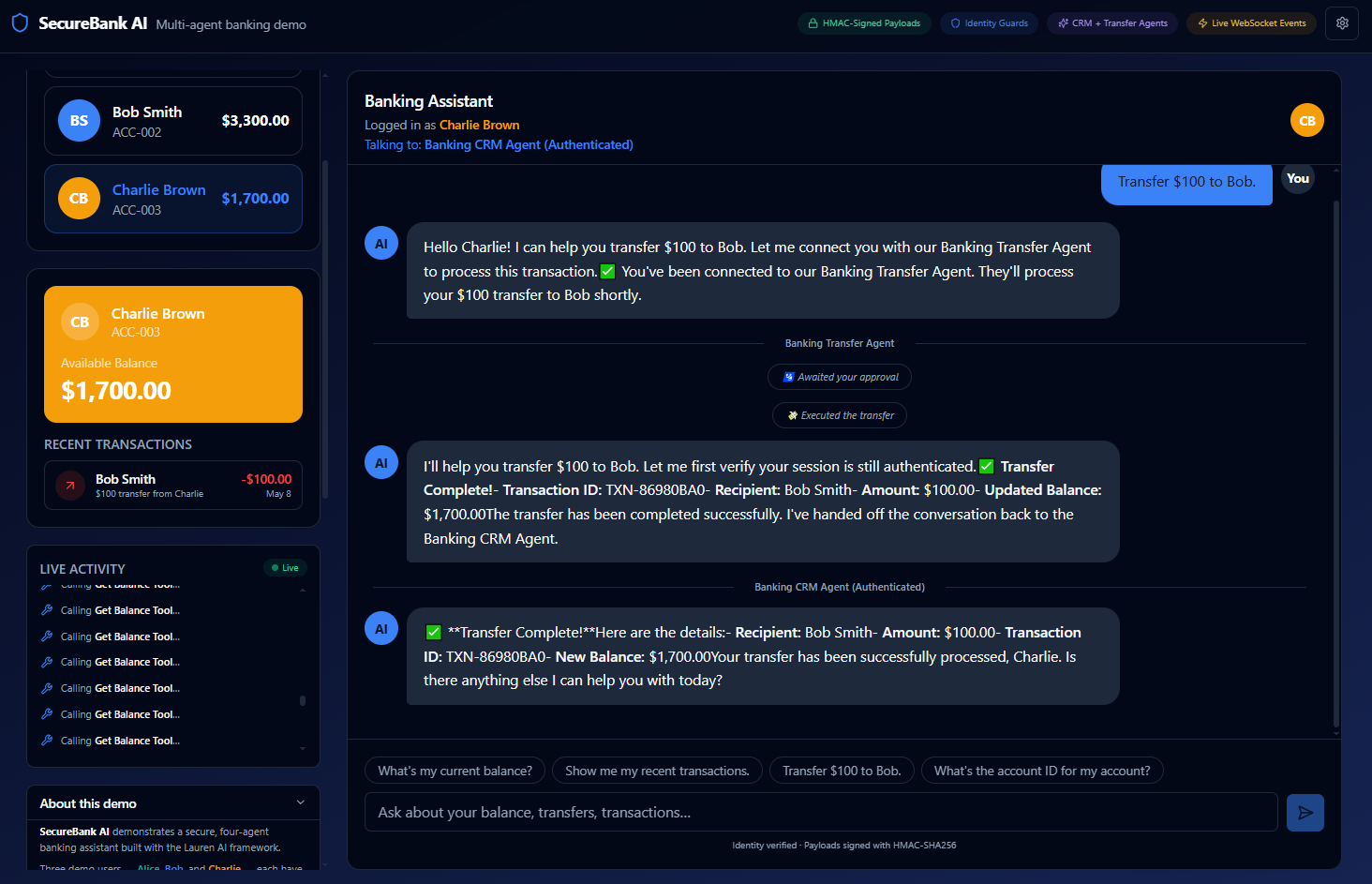
SecureBank remains the fastest way to see the stack end to end. The latest `lauren-ai` changes harden the core runtime with stricter startup validation, richer signal payloads, cleaner team exports, and safer DI-backed tool execution.
Open live demoFail-Fast Agent Startup
Agents now reject missing model configuration before the first turn begins, so miswired environments fail in development and CI instead of surfacing mid-conversation.
Richer Lifecycle Signals
Signal payloads now include fields like total_tokens and turns, making dashboards, billing views, and live telemetry UIs much easier to wire accurately.
Cleaner Team Event Streams
Team event exports and runner behavior are now easier to consume from streaming interfaces, so multi-agent timelines stay typed and predictable across app boundaries.
Safer DI Tool Execution
The tool executor now narrows DI-backed class tools more reliably, which reduces runtime ambiguity when tools are resolved from the container and invoked through run().
lauren-ai vs the alternatives.
Same endpoint, two implementations. See why structure wins.
@agent(model="claude-haiku-4-5-20251001",
       tools=[search], memory=RedisMemory())
class MyAgent:
    async def handle(self, msg: str) -> str:
        return await self.run(msg)
llm = ChatAnthropic(model="claude-haiku-4-5-20251001")
memory = ConversationBufferMemory()
agent = initialize_agent(
    tools, llm, memory=memory,
    agent=AgentType.CHAT_CONVERSATIONAL_REACT_DESCRIPTION,
)
result = agent.run(input=msg,
                   chat_history=memory.chat_memory.messages)
| Feature | LangChain | CrewAI | lauren-ai |
|---|---|---|---|
| Agent definition model | Function chains / LCEL | Role-based classes | @agent() decorator, DI-native |
| DI integration | None | None | Full Lauren IoC container |
| Type safety | Partial | Partial | End-to-end, mypy/pyright compliant |
| Testing support | Mock-heavy, flaky | Limited | MockTransport + AgentTestClient |
| Multi-agent coordination | LangGraph | Native | @team() with structured handoffs |
| Memory system | Various buffer classes | Basic | 4-tier: short-term / conversation / user-facts / vector |
| Guardrails | Manual | Manual | @guardrail() built-in |
| Provider switching | Various wrappers | Various wrappers | Single Transport interface |
| Streaming | Yes | Limited | First-class EventStream / SSE |
| Module system | None | None | NestJS-style modules with imports/exports |
At a glance
| Criterion | LangChain | CrewAI | lauren-ai |
|---|---|---|---|
| Type Safety | 🟡 | 🔴 | 🟢🟢 |
| DI Integration | 🔴 | 🔴 | 🟢🟢 |
| Testing Support | 🟡 | 🟡 | 🟢🟢 |
| Multi-Agent | 🟡 | 🟢 | 🟢🟢 |
| Memory System | 🟢 | 🟡 | 🟢🟢 |
| Guardrails | 🟡 | 🟡 | 🟢🟢 |
| Provider-Agnostic | 🟢 | 🟢 | 🟢🟢 |
| Production Ready | 🟡 | 🔴 | 🟢🟢 |
| Framework Integration | 🔴 | 🔴 | 🟢🟢 |
| Streaming | 🟢 | 🟡 | 🟢🟢 |
🟢🟢 = excellent · 🟢 = good · 🟡 = partial · 🔴 = missing
6 hard guarantees for production AI.
These are the release-level qualities reinforced by the latest runtime and typing changes, not just marketing promises.
Type-Safe Agents
Pydantic throughout. Every input, output, tool call, and memory entry is fully typed. pyright and mypy compliant — no Any escape hatches.
Typecheck by Default
Typing is part of the default developer flow now. The standard nox run includes mypy, so regressions are caught in everyday work rather than as a separate afterthought.
Deterministic Testing
MockTransport + AgentTestClient gives you reproducible test results every time. No flaky tests, no network calls, no API keys needed in CI.
Fail-Fast Configuration
Agent runners now reject missing model configuration before work starts, which turns a silent production misconfiguration into an immediate, debuggable startup error.
Streamable Team Events
Multi-agent team events export cleanly for UIs and orchestration layers. Team timelines are easier to consume, re-export, and type-check across app boundaries.
Richer Observability
Lifecycle signals expose more actionable data, including total_tokens and turns, so tracing, billing, and support dashboards can stay aligned with actual runtime behavior.